

Try Basic Fixes
- Reconnect the device: Unplugging your USB device and plugging it back in should help fix any issues caused by a loose connection. If you use a USB cable to connect your phone or hard drive to your computer, check the wire and the connector for damage.
- Try a different USB port or computer: You can try connecting your device to another USB port to see if that works. If you use a USB hub, try plugging your device directly into the computer. Alternatively, connect your USB device to another computer to check if it runs fine.
Fix 1: Check Power Management Settings
Choosing a stricter power usage profile for your laptop may also cause Windows to disable the drivers powering your USB devices. When that happens, your USB device might disconnect randomly. Here’s how to avoid that.
Step 1: Right-click on the Start icon > select Device Manager from the list.

Step 2: Double-click Universal Serial Bus controllers to expand it. Right-click on your USB driver > select Properties.

Step 3: Switch to the Power Management tab > uncheck the box that reads Allow the computer to turn off this device to save power > hit OK to save changes.

Repeat the above steps to disable the power-saving option for other USB drivers. After that, restart your PC and try using your USB device to check if the issue persists.
Fix 2: Check the USB Selective Suspend Setting
The USB selective suspend feature allows Windows to suspend USB ports on your PC to save power. This can also lead to issues like USB devices disconnecting and reconnecting on Windows. Hence, it’s best to disable this feature.
Step 1: Press the Windows key + S to open the search menu, type edit power plan, and press Enter.

Step 2: Click on Change advanced power settings.

Step 3: In the Power Options window, double-click on USB settings to expand it.
Step 4: Expand the USB selective suspend setting menu > click Enabled.

Step 5: Use the drop-down menu next to On battery and Plugged in to disable USB selective suspend.
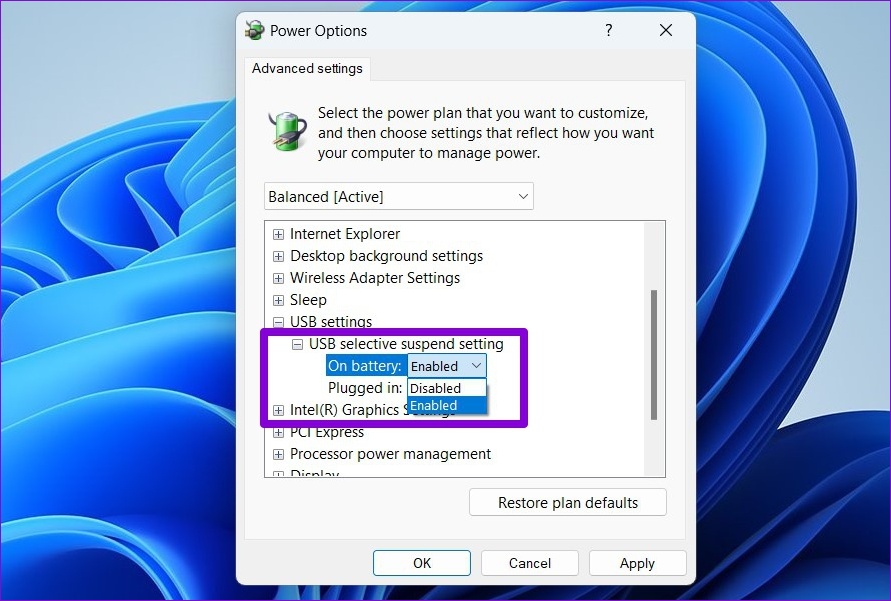
Step 6: Click on Apply > OK.
Fix 3: Run Hardware and Devices Troubleshooter
Windows 11 includes a Hardware and Devices troubleshooter that can automatically detect and resolve any common issues with peripheral devices. You can use this tool if the above solutions don’t work.
Step 1: Right-click on the Start icon > select Terminal (Admin) from the list.

Step 2: In the console, type the following command and press Enter.
msdt.exe -id DeviceDiagnostic
Step 3: In the Hardware and Devices window, hit Next to allow Windows to scan for issues.

Follow the on-screen instructions to run the tool and check if the issue persists.
Fix 4: Reinstall the USB Drivers
USB drivers on your PC help Windows communicate with your USB devices. If your USB devices keep disconnecting and reconnecting, Windows may have a driver problem. Try reinstalling the faulty USB drivers to see if that makes a difference.
Step 1: Press the Windows key + R to open the Run dialog box. Type devmgmt.msc in the box and press Enter.
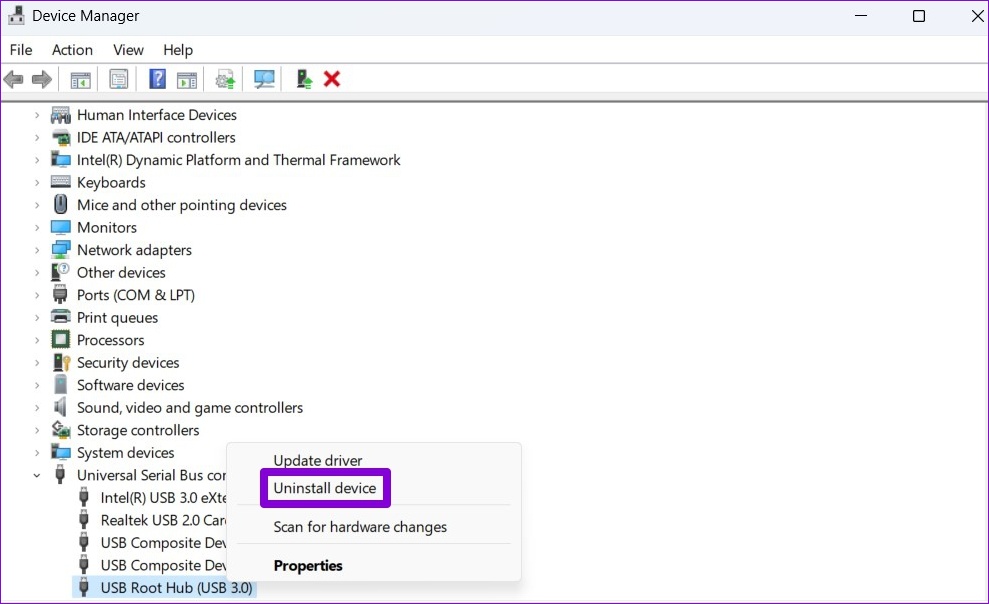
Step 2: Expand the Universal Serial Bus controller > right-click on the USB driver > select Uninstall device.
Step 3: Select Uninstall to confirm.
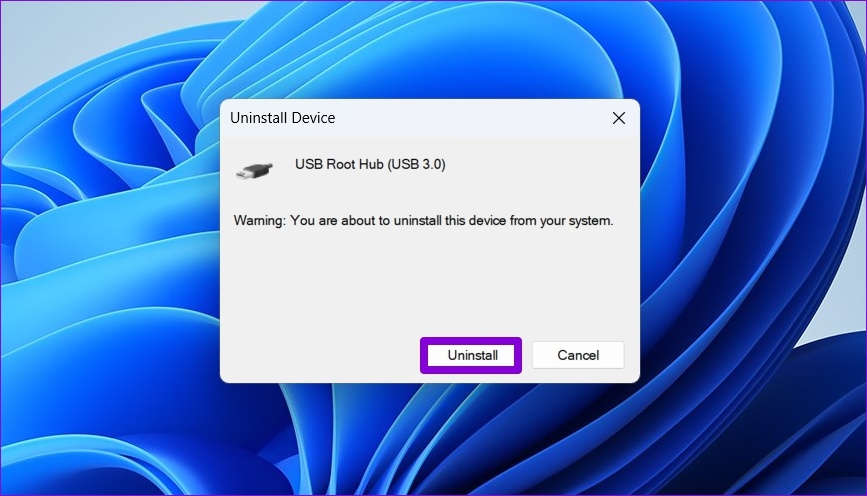
If your PC has multiple USB ports, you’ll see several entries under the Universal Serial Bus controller. In that case, repeat the above steps to uninstall each driver. After removing the USB drivers, restart your PC, and Windows should automatically install the missing USB drivers during boot. After that, USB devices will function normally.
Was this helpful?
Last updated on 12 August, 2024
1 Comment
Leave a Reply
Read Next
 4 Best Ways to Fix WhatsApp Reconnecting Issues on iPhone
Basic Fixes Restart iPhone: Restart your iPhone to fix any temporary bugs and glitches.
4 Best Ways to Fix WhatsApp Reconnecting Issues on iPhone
Basic Fixes Restart iPhone: Restart your iPhone to fix any temporary bugs and glitches.
 8 Best Ways to Fix Windows 10 Ethernet Keeps Disconnecting
On Windows 10 computers, both wired and wireless connections come with their respective problems.
8 Best Ways to Fix Windows 10 Ethernet Keeps Disconnecting
On Windows 10 computers, both wired and wireless connections come with their respective problems.
 6 Fixes if Windows 11 Is Not Recognizing USB Devices
Fix 1: Unlock and Trust the Device Some devices, like iPhones or Androids, have an added layer of authentication to verify user identity.
6 Fixes if Windows 11 Is Not Recognizing USB Devices
Fix 1: Unlock and Trust the Device Some devices, like iPhones or Androids, have an added layer of authentication to verify user identity.
 2 Ways to Fix Android Phone Keeps Disconnecting From Wi-Fi
Try Basic Fixes Disable interfering apps: VPNs and Wi-Fi prioritizing apps can sometimes interfere with your phone's network.
2 Ways to Fix Android Phone Keeps Disconnecting From Wi-Fi
Try Basic Fixes Disable interfering apps: VPNs and Wi-Fi prioritizing apps can sometimes interfere with your phone's network.
 6 Ways to Fix Mac Wi-Fi Keeps Disconnecting
Fix 1: Run macOS Wireless Diagnostics macOS has a built-in diagnostic tool to diagnose and fix connectivity problems on your Mac.
6 Ways to Fix Mac Wi-Fi Keeps Disconnecting
Fix 1: Run macOS Wireless Diagnostics macOS has a built-in diagnostic tool to diagnose and fix connectivity problems on your Mac.
 7 Best Ways to Fix Wear OS Smartwatch Keeps Disconnecting From Phone
A smartwatch is a great supplement to a smartphone.
7 Best Ways to Fix Wear OS Smartwatch Keeps Disconnecting From Phone
A smartwatch is a great supplement to a smartphone.
 4 Ways to Fix Android Auto Keeps Disconnecting
Basic Fixes Update the Android Auto app: Sometimes, the Android Auto interface may not support an old or outdated version of the app.
4 Ways to Fix Android Auto Keeps Disconnecting
Basic Fixes Update the Android Auto app: Sometimes, the Android Auto interface may not support an old or outdated version of the app.
 4 Ways to Fix Bluetooth Keeps Disconnecting on Android
Basic Fixes Use 5GHz Wi-Fi: Bluetooth uses a 2.4GHz frequency band, which can cause the signals to overlap and can cause problems by disconnecting the device.
4 Ways to Fix Bluetooth Keeps Disconnecting on Android
Basic Fixes Use 5GHz Wi-Fi: Bluetooth uses a 2.4GHz frequency band, which can cause the signals to overlap and can cause problems by disconnecting the device.
The article above may contain affiliate links which help support Guiding Tech. The content remains unbiased and authentic and will never affect our editorial integrity.

worked just fine for me. thank you!